
Quick answer: Valerian root usually starts working within 30 minutes to 2 hours of taking it, helping you feel calm and sleepy. For lasting sleep benefits, take 300–600 mg nightly for 2–4 weeks. It's non-addictive, but avoid it during pregnancy and with alcohol or sedatives.
Valerian root is an herb commonly used as a natural sleep aid. Research suggests it may help you fall asleep faster, improve sleep quality, and reduce anxiety and menstrual cramps — though it works best when taken consistently for 2–4 weeks.
In this article, our medical experts explain what valerian root does, what the research actually shows, how much to take, and who should avoid it.
What is valerian root?
Valerian is a perennial flowering plant native to Europe and Asia, now grown worldwide. The root is dried and used in teas, capsules, tinctures, and extracts.
Its use goes back over 2,000 years — Hippocrates described its benefits, and the Greek physician Galen later prescribed it for insomnia. Today it remains one of the most widely used herbal sleep aids in the world, sometimes called "nature's Valium" (though that comparison overstates its strength).
How does valerian root work?
Valerian root contains compounds — mainly valerenic acid — that interact with GABA (gamma-aminobutyric acid) receptors in the brain. GABA is a calming neurotransmitter; low levels are linked to anxiety and poor sleep. Valerian appears to increase GABA availability, helping the nervous system relax.
This is the same neurotransmitter system targeted by anti-anxiety medications like benzodiazepines, but valerian acts far more gently. It also contains antioxidants (hesperidin and linarin) that may have additional calming and sleep-enhancing properties.
5 science-backed benefits of valerian root
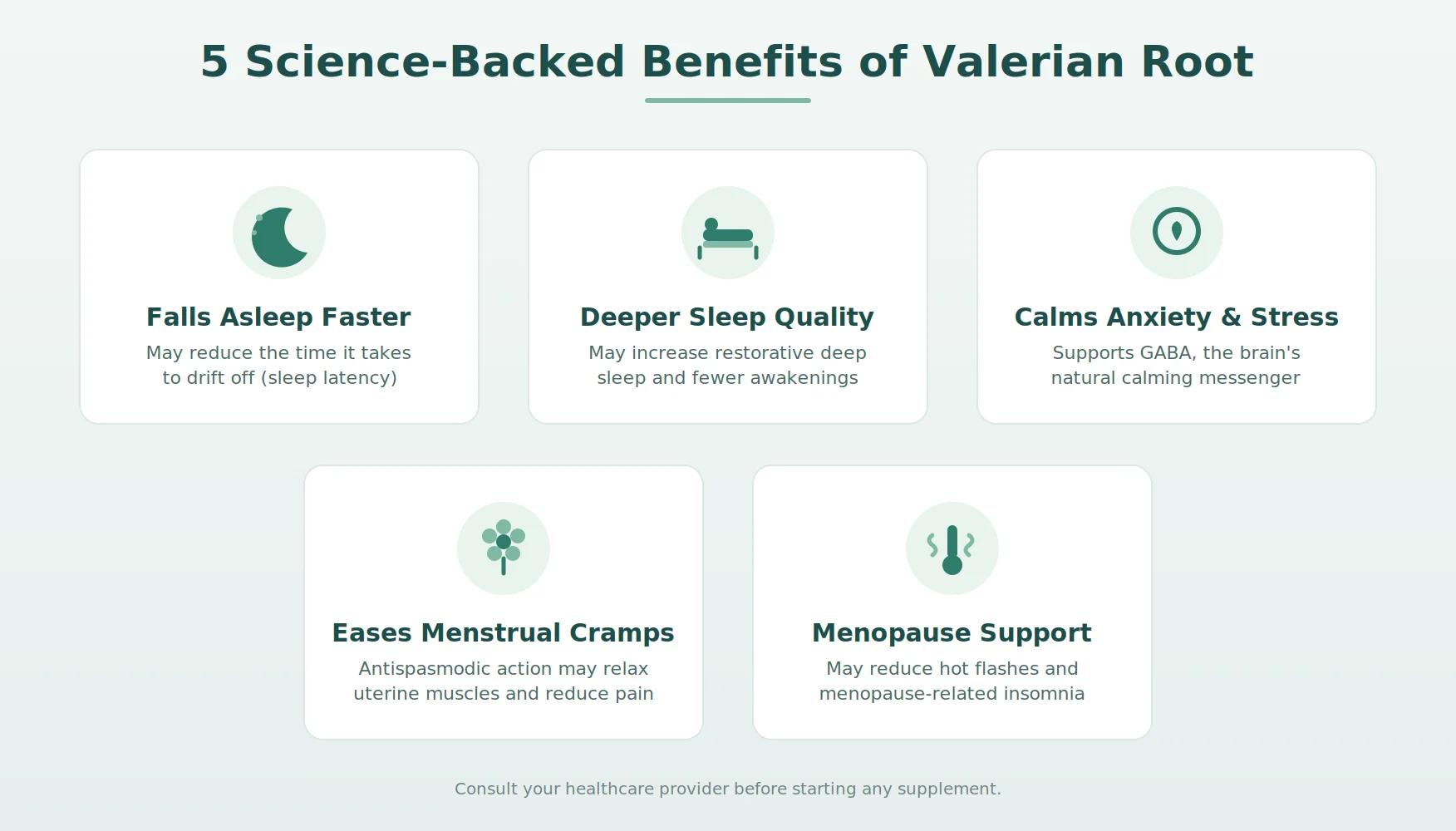
1. May help you fall asleep faster
Valerian's best-studied benefit. A frequently cited systematic review in the American Journal of Medicine (Bent et al.) found people taking valerian were more likely to report improved sleep quality than those on placebo. Some studies show it may reduce the time it takes to fall asleep (sleep latency).
What the research says: Effects are usually modest and build over 2–4 weeks of consistent use — it is not a "knockout pill" that works on night one for everyone.
2. May improve sleep quality
Beyond falling asleep, valerian may increase time spent in deep, restorative sleep and reduce night-time awakenings. A 2020 meta-analysis in the Journal of Evidence-Based Integrative Medicine (Shinjyo et al., 60 studies) concluded valerian can be a safe and effective herb to promote sleep, with results most reliable when whole-root preparations of consistent quality were used.
3. May reduce anxiety and stress
The same GABA mechanism that supports sleep also calms an overactive mind. Several clinical trials report reduced anxiety scores in people taking valerian, including situational stress (for example, before medical procedures). It may help you feel less "wired" during high-pressure days.
4. May ease menstrual cramps and PMS
Valerian has antispasmodic properties — it helps relax smooth muscle, including the uterus. In a randomized controlled trial published in the International Journal of Gynecology & Obstetrics, women who took valerian three times daily during their period reported significantly less menstrual pain than the placebo group.
5. May reduce menopause symptoms
Small clinical trials suggest valerian may reduce the frequency and severity of hot flashes in menopausal women, and its sleep benefits are especially useful for menopause-related insomnia. Evidence here is promising but still limited.
How to take valerian root?

Forms of valerian
- Capsules/tablets — easiest way to get a consistent, measured dose
- Tea — steep 1 teaspoon (2–3 g) dried root in hot water for 10–15 minutes
- Tincture/liquid extract — mixed into water; faster absorption
- Combination formulas — often paired with hops, lemon balm, chamomile, or passionflower
Valerian root dosage
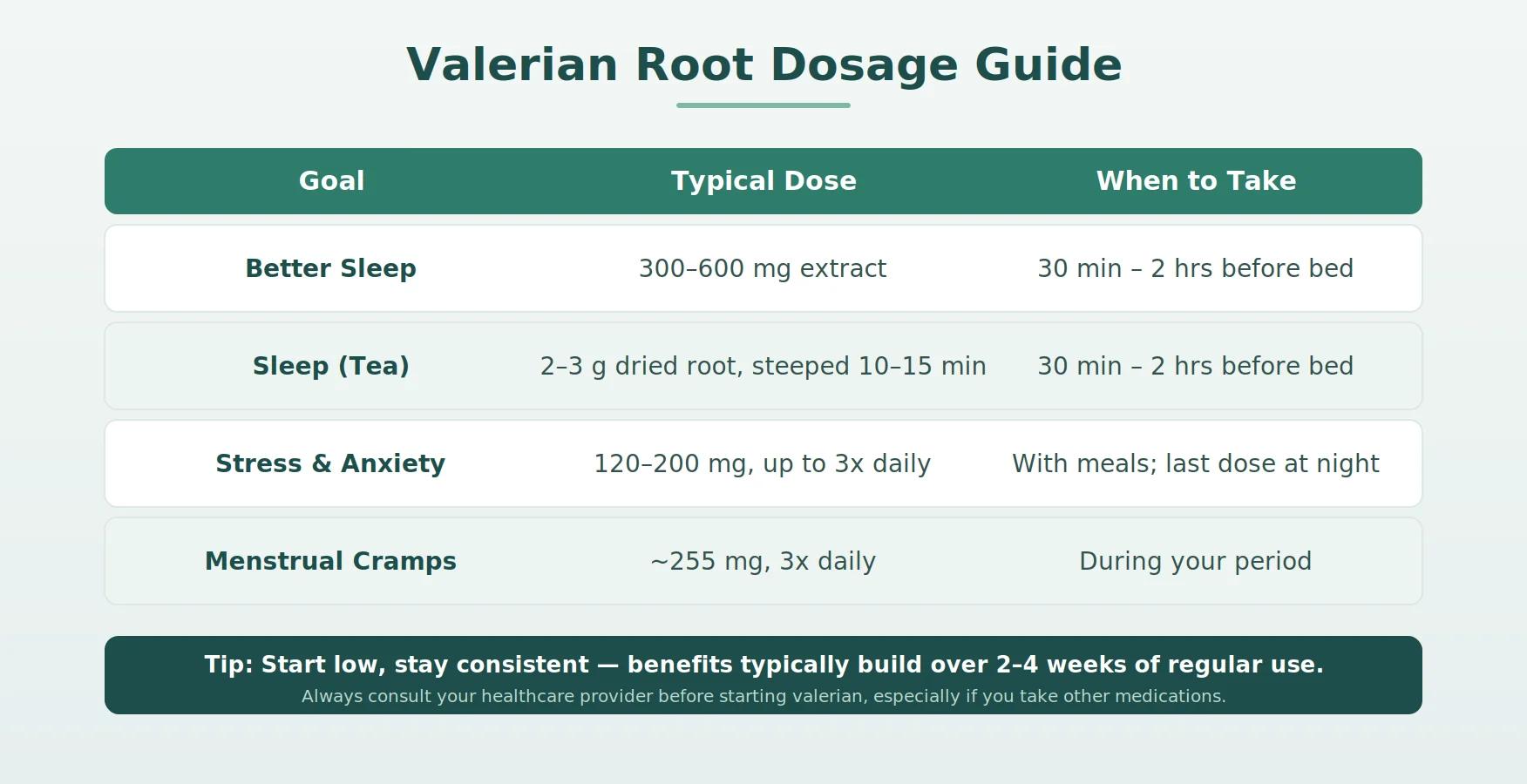
| Goal | Typical dose | When to take |
| Sleep | 300–600 mg extract | 30 min – 2 hours before bed |
| Sleep (tea) | 2–3 g dried root | 30 min – 2 hours before bed |
| Anxiety/stress | 120–200 mg, up to 3x daily | With meals; last dose at night |
| Menstrual cramps | ~255 mg, 3x daily | During your period |
Start at the lower end to assess tolerance, and use it consistently — most studies showing benefits ran for at least 2–4 weeks. Doses up to 900 mg have been studied for sleep, but higher doses increase the chance of next-day drowsiness without clearly working better.
How long does valerian root take to work?
For some people, a single dose produces noticeable relaxation within 30 minutes to 2 hours. For meaningful improvements in insomnia, expect 2 weeks or more of nightly use before judging whether it works for you.
Side effects of Valerian Root
Valerian root is generally well tolerated for short-term use; most studies lasted 4–8 weeks. Side effects are usually mild and include:
- Headache or dizziness
- Stomach upset, diarrhea, or constipation
- Vivid dreams
- Morning drowsiness (mostly at doses above 900 mg)
- Restlessness or alertness instead of calm, in a small number of people
- Dizziness in older adults, which may increase the risk of falls
Valerian is not considered addictive and does not appear to cause dependence the way prescription sleep medications can. That said, if you've used it nightly for a long period, taper off gradually rather than stopping abruptly.
Who should not take valerian root?
Avoid valerian root, or talk to a doctor first, if you:
- Are pregnant or breastfeeding (safety data is insufficient)
- Take sedatives, sleeping pills, benzodiazepines, or antidepressants — valerian can intensify their effects
- Drink alcohol in the evening — the combination amplifies sedation
- Have liver disease
- Are due for surgery within 2 weeks (it can interact with anesthesia)
- Are giving it to a child — only under medical supervision
Valerian root vs. melatonin: which is better for sleep?
They work differently. Melatonin is a hormone that signals your body it's time to sleep — best for jet lag, shift work, and a disrupted body clock. Valerian calms the nervous system — better suited when stress or a racing mind keeps you awake. They can be taken together safely by most people, and some supplements combine both. If anxiety is the reason you can't sleep, valerian may be the better fit; if timing is the problem, choose melatonin.
Try a standardized valerian supplement
One challenge with valerian is that potency varies widely between brands and raw root preparations. A standardized extract ensures you get a consistent dose in every capsule. VALIAN-X contains standardized valerian root extract, formulated to support faster sleep onset and a calmer mind.
As with any supplement, consult your healthcare provider before use.

Conclusion
Valerian root is one of the best-researched herbal options for better sleep and a calmer mind. The evidence suggests modest but real benefits for sleep quality, anxiety, and menstrual discomfort, with a strong safety profile for short-term use.
It works best as part of a complete routine: consistent sleep schedule, limited screens before bed, and stress management. And as with any supplement, check with your healthcare provider before starting — especially if you take medication.
Meet our expert

Meet our expert
Chai Jie Qi is a passionate nutritionist and fitness professional with a strong background in healthcare, wellness, and fitness. With over five years of experience in the healthcare industry and a journey in fitness and wellness since 2015, Chai is dedicated to helping individuals achieve their health goals through a well-rounded approach.



How was the experience with article?
We'd love to know!