
Ever felt that sudden, throbbing catch in your lower back—like your body just hit pause on you? Ouch.
If you're nodding, you're not alone. Lower back pain is one of the most common and disruptive issues among adults today, especially if you're juggling long hours at a desk, non-stop errands, and screen-hopping from day to night.
According to the Global Burden of Disease study, low back pain is now the leading cause of disability worldwide. And yet, the solution may be far simpler than you think.
A study published in JAMA Network Open found that walking more than 100 minutes per day may reduce the risk of chronic low back pain by about a quarter compared to walking less than 78 minutes per day. The study, which involved approximately 11,200 people in Norway, observed that the benefits of walking for chronic back pain plateaued after about 100 minutes. This suggests that a simple, accessible activity like walking can significantly impact the prevention of chronic low back pain.
That’s right — something as basic as putting one foot in front of the other could be your body’s natural pain relief remedy.
Whether it's poor posture, obesity, stress, or a sedentary routine, many everyday habits quietly contribute to back pain. But the good news? A consistent walking routine can counteract these triggers and build long-term resilience.
In this blog, we dive into how this simple habit can ease discomfort, protect your spine, and boost your overall well-being, step by step.
Why chronic lower back pain is so common
Back pain is chronic if it lasts three months (12 weeks) or longer. You may experience the pain as muscle tightness or stiffness, tingling, numbness, weakness, or sudden muscle twitches. Pain may also spread (radiate) from your back to other areas, like your butt, hips, or legs.
- Chronic back pain is usually age-related, but it can also result from an injury (like lifting a heavy object) or from prolonged, repetitive movements (like constantly bending down at work), and many struggle with it.
- Sitting for long hours, poor posture, and even prolonged lower back pain when walking or standing for long periods tend to wear down your spine and cause stiffness. These habits strain muscles and joints, reducing mobility and quality of life.
- Weight gain is another culprit. Natural disc wear and tear combined with excess body weight stresses spinal joints and causes lower back pain.
- Osteoarthritis can affect the lower back. In people with arthritis in the spine, there is narrowing of the space around the spinal cord (a condition called spinal stenosis).
But there’s good news: a simple change in your lifestyle can help.
Walking daily: What does the study say?
- Studies published in JAMA Network Open show that walking daily for at least 78 to more than 100 minutes per day can significantly reduce the risk of developing chronic lower back pain.
- This study involved over 56,000 people in Norway. Between 2017 and 2023, they shared health and lifestyle info.
- In one phase, over 31,000 participants wore motion trackers on their thighs and lower back for a week to measure how much and how fast they walked (slow, moderate, or brisk).
- To check for chronic lower back pain, they were asked if they had pain or stiffness in their lower back lasting 3+ months in the past year.

Study Results
- People who walked at least 78 minutes daily had a lower risk, and those walking over 100 minutes a day had a 23% lower risk than those walking less.
- The best results were seen in people who walked 125 minutes or more each day.
- The benefits were even stronger in adults over 65.
- Walking at a moderate or brisk pace also lowered the risk, but walking faster didn’t always mean better results.
- Interestingly, walking more helped more than just walking faster. Those who walked less than 125 minutes daily still saw benefits if they walked at a moderate intensity.
Thus, the study points out that even moderate, consistent walking supports spinal stability and helps prevent the progression of pain.
Benefits of walking daily for your back
- A 2020 study found that walking is more effective in the intermediate term to relieve pain and improve function in patients with chronic lower back pain (CLBP).
- Research also suggests that going for a walk or brisk walking (Nordic walking) can help relieve back pain if done regularly, for instance, every two days for 30 to 60 minutes.
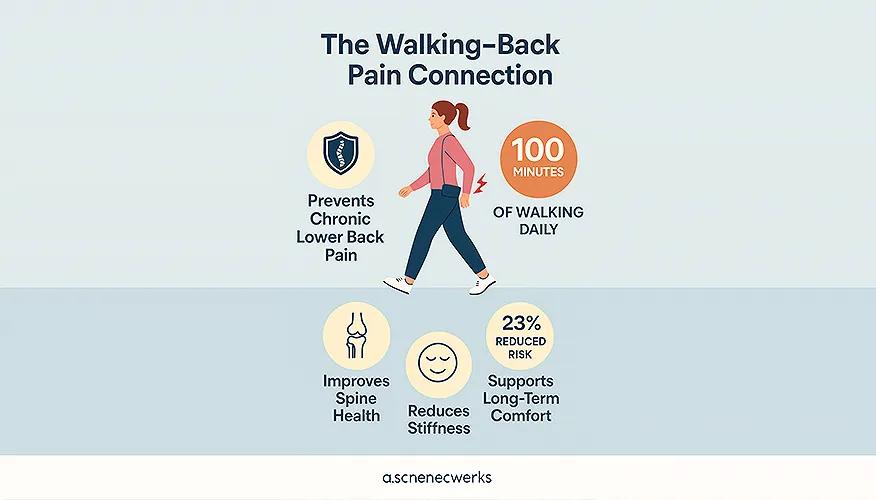
Walking daily supports your back
- Weak back and stomach muscles may not support the spine (core strength). Walking activates postural muscles and improves spinal alignment.
- It increases blood circulation, reduces inflammation, and muscle stiffness.
- It reduces muscle tension and boosts joint mobilization.
- Walking at a moderately intense pace stimulates the release of endorphins, the body’s natural feel-good hormones that reduce perceived pain and stress.
What if walking triggers pain, not relief?
You may have a job that involves heavy lifting, bending, twisting, or whole body vibration, such as using a sandblaster. It strains your back quite a lot. Lower back pain when walking or standing for long periods can also be a challenge.
Here’s how you can prevent that:
- Check your posture at work and rest.
- Lengthen your back, and try not to slouch or lean forward.
- Choose supportive footwear to reduce strain on your back
- Start with short, low-impact walks. Gradually build your walking time, adding five minutes a week.
- Walk on even surfaces.
- Include light stretches before and after walks to ease muscle tension.
- Add core-strengthening and back-strengthening exercises in your routine.
- Eat anti-inflammatory foods (leafy greens, berries, etc.) to calm irritated tissues.
- Mindfulness or breathing exercises lower muscular tension that often settles in the lower back.
- Consult a physical therapist if pain persists.
Walk your way out of back pain
- Walking is one of the easiest and most popular ways to stay active. You don’t need fancy gear or special skills to do it.
- It also improves blood flow, lowers blood pressure, and boosts energy by releasing endorphins and increasing oxygen delivery.
- It improves high blood pressure and body mass index, lowers the risk of diabetes, stroke, and cardiovascular disease, and early death.
- Whether you walk outside in nature, on busy city streets, on a treadmill, or just around your office, it’s a simple and accessible way to boost your health.
How much is enough?
- CDC recommends 150 to 300 minutes (2 hours and 30 minutes to 5 hours) of moderate-intensity aerobic physical activity each week for adults. So, 30 minutes of brisk walking every day is suggested.
- Adults should target an average daily walking distance 4 to 5 kilometers.
- If it sounds daunting, remember that steps add up quickly: a 10-minute stroll after each meal, doing incidental exercise like a brisk walk to grab groceries, taking steps to ditch the elevator, cleaning your house, or parking farther from the office door all count.
- According to Research, approximately 7,000-8,000 steps/day is a reasonable threshold of free-living physical activity, associated with current public health guidelines.
Conclusion
Chronic lower back pain is common amongst people of all ages. The benefits of walking daily are many, and everyone can do it with minimal effort, unless you have any balance issues, muscle weakness, or other physical disabilities. It not only improves cardiovascular health, strengthens muscles, boosts mood, but also aids in weight management by burning calories and increasing metabolism.
According to the study, moderate to brisk walking up to 125 minutes per day is ideal for reducing lower back pain by 23%. Regular walking, whether done in small increments or longer bouts, is an accessible and effective way to support back health.
So the next time your back starts to grumble after a day at the desk, remember that the simplest prescription, ‘the baby steps’, might be the most powerful!
Meet our expert

Meet our expert
A graduate from Lugansk State Medical University in 1995, Dr Viktorovona holds a distinguished qualification in pediatrics, ultrasound diagnostics, and pediatric gastroenterology.



How was the experience with article?
We'd love to know!