
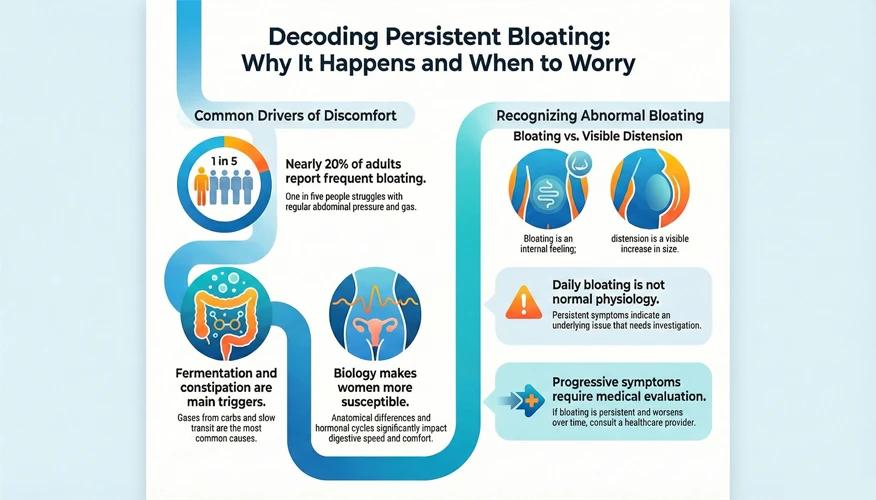
Nearly one in five reported feeling bloated at least once a week. So, if your abdomen feels tight and heavy most days, you are experiencing a common but disruptive problem.
Still, when bloating shows up daily, it quietly changes how you eat, how you dress, and sometimes how confidently you move.
For people diagnosed with irritable bowel syndrome, up to 96% report always feeling bloated, and more than half say it is their most distressing symptom, even more than pain.
In this article, we’ll discuss how bloating is about how your gut and your brain interact, how your muscles coordinate, and how your body handles what you feed it.
What does being bloated feel like?
When you say you always feel bloated, you are describing a sensory experience. Your abdomen feels full, stretched, or pressurized. Clinically, that sensation is called bloating.
Distension, however, refers to a visible and measurable increase in abdominal size. The two can occur together, but they do not have to. You can feel intense pressure without any visible swelling. You can also look distended while feeling only mild discomfort.
Imaging studies and 24-hour abdominal monitoring show that even healthy adults experience a small increase in abdominal girth after meals. That expansion usually resolves overnight. In people with functional gut disorders, the increase is larger and lasts longer.
Your gut contains more than 100 million nerve cells. These nerves send signals to your brain about stretching and movement. When visceral hypersensitivity develops, your brain interprets normal levels of fluid as always bloated and gassy.
Stress, anxiety, and prior gastrointestinal infections can heighten this response. Therefore, you feel severe bloating even when gas volumes fall within normal ranges.
Is it normal to always be bloated?
Constant bloating is not usually considered normal. While occasional bloating after large meals, salty foods, or certain carbohydrates is common, persistent or daily bloating may indicate an underlying issue.
After eating a large meal, your colon expands to accommodate incoming material. MRI studies show the ascending colon can increase its volume by about 10% after a standard meal. Gas is absorbed or expelled over several hours, and fluid is reabsorbed through the intestinal lining. By morning, abdominal size typically returns to baseline.
When you wake up already distended, that overnight reset did not occur. Persistent daily bloating that interferes with your life is not considered normal physiology. According to the Rome IV criteria, symptoms occurring at least one day per week for three months, with onset at least six months earlier, qualify as chronic functional bloating. Constant bloating signals disrupted gut motility, abnormal fermentation, impaired gas handling, or muscle coordination problems.
Some common causes of chronic bloating include:
- Digestive disorders: Irritable bowel syndrome (IBS), small intestinal bacterial overgrowth (SIBO), celiac disease, or lactose intolerance.
- Constipation: Stool buildup causes gas and pressure.
- Food sensitivities: Dairy, gluten, or high-FODMAP foods can trigger bloating.
- Hormonal fluctuations: Particularly in women, estrogen and progesterone changes can cause water retention and bloating.
- Swallowing excess air: From chewing gum, drinking through straws, or eating quickly.
- Gut dysbiosis: An imbalance in gut bacteria can lead to gas and bloating.
Red flags to see a doctor:
- Unintentional weight loss
- Blood in stool
- Severe abdominal pain
- Persistent vomiting
- Bloating that suddenly worsens
If bloating is constant, a medical evaluation is recommended to rule out underlying conditions.
Common GI symptoms you shouldn’t ignore
Most bloating is functional. However, specific associated symptoms increase the likelihood of structural disease.
- Unintentional weight loss exceeding 10% of your body weight suggests malabsorption, inflammation, or malignancy. Blood in the stool indicates mucosal injury or tumors.
- Iron deficiency anemia may be caused by continuous microscopic hemorrhage. Persistent vomiting may indicate blockage or serious motility issues. New symptoms that appear beyond the age of 50 are also cause for concern.
Moreover, bloating that does not improve overnight deserves attention. Functional bloating fluctuates with meals and bowel movements. Relentless, progressive distension does not follow that pattern. Therefore, persistent symptoms require medical evaluation rather than dietary experimentation alone.
Infographic outlining four common causes of bloating, and explaining why the abdomen feels tight and swollen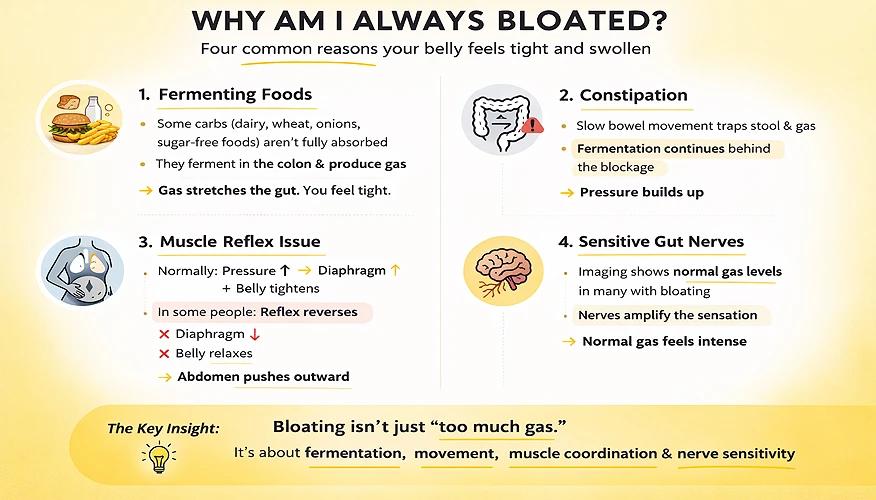
Common reasons why you’re always bloated
Once serious pathology is excluded, several mechanisms explain ongoing bloating.
Once serious medical conditions are ruled out, ongoing bloating usually comes down to a few very common digestive patterns.
1. Certain foods ferment in your gut
One of the biggest reasons is something called fermentation.
Some carbohydrates are not fully absorbed in the small intestine. These include:
- Lactose (in milk and dairy)
- Excess fructose (in certain fruits and sweetened drinks)
- Fructans (found in wheat and onions)
- Sugar alcohols (often added to “sugar-free” or processed foods)
When these carbohydrates aren’t absorbed properly, they pull water into the gut. Then they travel to the large intestine, where gut bacteria break them down.
During this breakdown process, gases like hydrogen, methane, and carbon dioxide are produced.
That gas buildup stretches the intestines — and that’s when you feel tight, swollen, and uncomfortable.
2. Constipation traps gas inside
If you’re not passing stools regularly, bloating becomes much more likely.
In fact, more than 80% of people with slow transit constipation report feeling bloated.
Here’s why: When stool sits in the colon for too long, it blocks the normal movement of gas and new digestive contents. Meanwhile, fermentation continues behind that “blockage,” increasing pressure inside the abdomen.
The result? A heavy, stretched-out feeling that doesn’t go away.
3. Your abdominal muscles may not respond properly
Normally, when there’s a slight increase in gas or internal pressure, your body automatically adjusts. The diaphragm moves upward and the abdominal wall tightens slightly. This reflex prevents your belly from visibly protruding.
But in some people, this reflex works in reverse. The diaphragm moves downward, and the abdominal wall relaxes instead of tightening.
This makes the abdomen push outward — even if the amount of gas inside isn’t very high.
4. It’s not always “too much gas”
Here’s something surprising.
Imaging studies often show that people who feel severely bloated don’t actually have excessive amounts of gas. Instead, their nerves are more sensitive.
This means normal levels of gas can feel intensely uncomfortable because the brain interprets the signals as stronger than they actually are.
So sometimes, bloating isn’t about having “too much” inside — it’s about how strongly your body reacts to what’s already there.
How to relieve bloating fast
A structured low FODMAP diet reduces fermentable carbohydrates. Clinical trials demonstrate significant reductions in bloating severity when these foods are restricted and gradually reintroduced. Therefore, targeted dietary modification can directly lower gas production.
If constipation drives symptoms, gradual fiber adjustment, adequate hydration, and prescription medications that stimulate intestinal secretion or motility can restore transit. Faster movement reduces fermentation time as well as gas accumulation.
For confirmed bacterial overgrowth, non-absorbed antibiotics such as rifaximin reduce bacterial load and fermentation. Controlled trials show measurable decreases in bloating scores after treatment.
Biofeedback therapy addresses abdominophrenic dyssynergia. Patients learn to coordinate diaphragm relaxation with abdominal wall contraction. Studies demonstrate a visible reduction in distension following training.
Also, simple behavioral changes matter. Eating slowly reduces swallowed air. Light activity after meals stimulates gut movement. Stress reduction lowers sympathetic activation, which otherwise slows digestion.
To know more about good foods for the gut, download our flipbook: Good Foods For A Good Gut
Is constant bloating more common in women?
Large surveys show women report frequent bloating about twice as often as men. The average female colon is longer, about 154 centimeters, versus 147 in men, and it fits into a smaller pelvic space, which slows transit.
Women also average 47 hours of colonic transit compared with 33 hours in men, so fermentation increases. Hormones contribute as well. Estrogen promotes fluid retention and increases gut pain sensitivity, while progesterone slows motility, especially before menstruation.
When to see a doctor
Most chronic bloating is functional; however, persistent and progressive distension needs evaluation.
Ovarian cancer often presents with steady bloating that does not improve overnight, plus early fullness or urinary urgency can contribute to it.
Persistent distension has a higher probability of being cancerous than symptoms that come and go. If you have new, chronic, or associated bloating with weight loss, anemia, bleeding, fever, or severe discomfort, you should consult a doctor right away.
Conclusion
If you feel bloated often, you are not imagining it, and you are not alone. So instead of blaming yourself or guessing, you need to understand what is driving it. Your bloating may come from fermentation, slow transit, nerve sensitivity, or muscle coordination. Once you identify the cause, you can act on it directly.
However, you also need to know when bloating is not routine. If your symptoms are persistent, progressive, or paired with weight loss or bleeding, you should seek medical care. When you pay attention to patterns and respond early, you protect your health and regain control.
Meet our expert

Meet our expert
Ng Juby is a Registered Nutritionist under the Allied Health Professional Act 774, holding
a Bachelor of Science (Hons) in Nutrition with Wellness from UCSI University.



How was the experience with article?
We'd love to know!