
If your stomach feels swollen, tight, or heavier than usual just before or during your period, you’re not alone — period bloating is one of the most common yet least talked about menstrual symptoms. For many women, it appears every month, often alongside cramps, fatigue, or changes in digestion, making everyday life feel just a little more uncomfortable.
In fact, clinical guidance from the American College of Obstetricians and Gynecologists highlights bloating as a core symptom of premenstrual syndrome (PMS), affecting a large proportion of women globally. Estimates supported by the National Institutes of Health suggest that up to 3 in 4 women experience PMS symptoms at some point in their reproductive years—with bloating being one of the most noticeable.
So, what’s really happening inside the body?
As your cycle progresses, natural shifts in estrogen and progesterone begin to influence more than just your reproductive system. These hormonal changes can affect how your body retains fluid and how your digestive system functions. Research published in the World Journal of Gastroenterology shows that fluctuations in these hormones can slow gut movement and increase sensitivity, leading to that familiar feeling of fullness, pressure, or puffiness around the abdomen.
The good news is — period bloating is temporary, manageable, and a normal part of the menstrual cycle for many women. Understanding why it happens is the first step to easing the discomfort and feeling more in control of your body each month.
In this article, we’ll explore what causes period bloating, when it typically starts, how long it lasts, and simple, practical ways to reduce it — so you can move through your cycle with greater comfort and confidence.
What is period bloating?
Your period bloating is usually a temporary state of discomfort in the abdomen associated with your menstrual cycle that comes with puffiness, and may or may not come with swelling or distension. Period bloating usually arises from fluid retention.
Fluid retention peaks on the first day of menstrual flow, declining rapidly thereafter. This self-perceived bloating correlates more with hormonal shifts than measurable swelling, though it can mimic it through sensations of bloating or up to 3 kgs of weight gain.
Common causes of period bloating
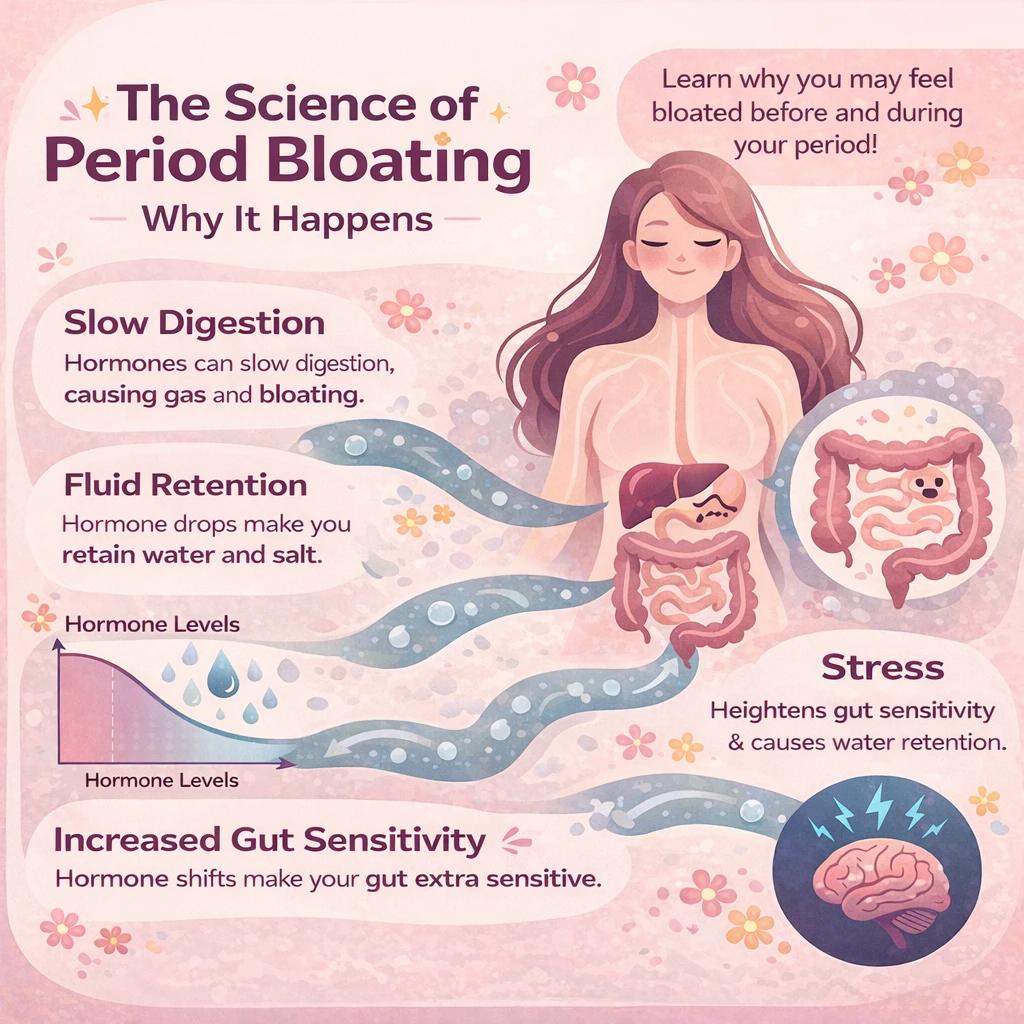
If you feel unusually full, gassy, or tight around your period, it usually comes down to how your body responds to hormonal changes, not just in your uterus, but in your gut too.
- As your period begins, your body releases prostaglandins to help shed the uterine lining. These same chemicals can also slow down digestion, so food and gas move more slowly through your system. In fact, insights from the American College of Gastroenterology highlight how these compounds can influence gut movement and contribute to symptoms like bloating and discomfort.
- At the same time, shifts in estrogen and progesterone affect how your body holds on to salt and water. When progesterone drops just before your period, your body may temporarily retain more fluid—adding to that swollen feeling. Hormonal effects on fluid balance have also been explored by the Endocrine Society.
- You might also notice bloating at other points in your cycle. Around ovulation, rising estrogen can cause mild fluid retention, which explains why some women feel bloated more than once in a month.
But hormones aren’t the whole story.
- If your gut is more sensitive, even normal amounts of gas can feel uncomfortable. Women with Irritable Bowel Syndrome, for example, often report increased bloating around their cycle, according to the International Foundation for Gastrointestinal Disorders. Stress can make this worse by heightening gut sensitivity through the gut–brain connection, a link widely discussed by Harvard Medical School.
Takeaway:Period bloating is mainly caused by hormonal shifts that slow digestion and increase fluid retention—sometimes made worse by gut sensitivity and stress.
Symptoms of period bloating
The most common symptom of period bloating is a sense of abdominal fullness or, in some cases, a visible swelling.
You feel pressure, heaviness, or mild pain rather than sharp cramps. Don’t be alarmed if you notice breast tenderness and short-term weight changes (mostly gain) during your period if you have a bloating problem.
Your bowel habits may shift as well. About 25% of women experience constipation in the later part of the cycle, while around 15% deal with loose stools during menstruation.
Imaging studies show that even when you feel gassy, the actual gas volume inside the intestines does not increase significantly. Your nervous system simply interprets it more intensely.
Here is a quick recap of the symptoms you may feel:
- Abdominal fullness
- Visible distension
- Pelvic pressure
- Heavy sensation
- Mild pain
- Breast tenderness
- Weight gain
- Constipation
- Loose stools
- Gas sensitivity
- Bowel discomfort
- Gut hypersensitivity
Let’s now discuss a bit about when you may expect the bloating to end.
How long does period bloating last?
For most, bloating lasts between 3 and 7 days. It usually peaks on day one of bleeding and eases by day 4 or 5 as hormone levels stabilize. If you have IBS, period bloating may last longer. Even then, symptoms rarely extend beyond ten days unless another condition is present.
If you run regularly or stay very active, you may not feel much difference in the duration, but the intensity may feel higher.
Tips for managing period bloating
If period bloating is making you feel heavy or uncomfortable, small daily habits can make a noticeable difference.
- Start with hydration. Drinking enough water — around 2 to 3 liters a day helps your body release excess fluid instead of holding on to it. Pair this with keeping salt intake in check, as too much sodium can worsen water retention.
- Movement also helps more than you might expect. Gentle activity like walking, stretching, or yoga supports digestion and reduces that “stuck” feeling in your gut. Even light movement during your period has been linked to fewer bloating symptoms over time.
- How you eat matters too. Smaller, more frequent meals are easier to digest and can prevent your gut from feeling overloaded—especially when digestion naturally slows during your cycle.
- Finally, simple comfort measures can go a long way. A warm heating pad placed on your abdomen can relax muscles and ease the internal pressure linked to prostaglandins.
Home remedies to treat period bloating
Some simple remedies that can be effective during period bloating are:
- Peppermint or mint tea (1–2 cups daily): Helps relax gut muscles and reduce gas
- Ginger (tea or 500–1000 mg): Supports digestion and reduces inflammation
- Fennel or chamomile tea (1–2 cups daily): Eases digestive discomfort and bloating
- Probiotic yogurt (1 serving daily): Supports healthy gut bacteria
- Magnesium (300–400 mg): May help reduce water retention and muscle tension
- Warm baths (15–20 minutes): Relaxes the body and eases discomfort
- Abdominal massage (5–10 minutes): Encourages gas movement and relieves pressure
- Avoid gum and chewables: These can increase air swallowing and worsen bloating
Medical treatments for severe period bloating
When bloating disrupts work or sleep, a few medical approaches can bring relief. Nonsteroidal anti-inflammatory drugs like ibuprofen can help alleviate your period bloating symptoms in a day or two.
Hormonal contraceptive pills cut bloating severity by about half in many women by preventing sharp rises and drops in hormonal levels. For those with significant fluid retention, medications like spironolactone can help by maintaining fluid balance in the body.
If PMS bloating overlaps with irritable bowel syndrome, antispasmodic medications often bring relief to gut muscles.
When to see a doctor
You should seek medical advice when your bloating lasts longer than ten days, worsens over time, or appears with intense symptoms. Also, notice if you incur unexplained weight loss, blood in stool, severe pain, vomiting, or fever.
Such patterns are not to be ignored and point away from normal cycle changes and toward conditions like endometriosis, ovarian cysts, inflammatory bowel disease, or fibroids.
Conclusion
Period bloating reflects the coordinated effects of hormones on fluid balance, gut motion, and nerve sensitivity. Large prospective studies confirm that it peaks at the start of menstruation across many cycle types.
While benign, it affects comfort and daily life, especially when combined with painful periods or digestive sensitivity. By recognizing its cyclic nature and using lifestyle strategies, home remedies, and targeted treatments, you gain real control over a monthly experience that once felt unpredictable.
Meet our expert

Meet our expert
Dr Adwoa Agyei-Nkansah is a fellow of the West African College of Physicians, a fellow of the Royal College of Physicians, London and a member of the American College of physicians.
How was the experience with article?
We'd love to know!