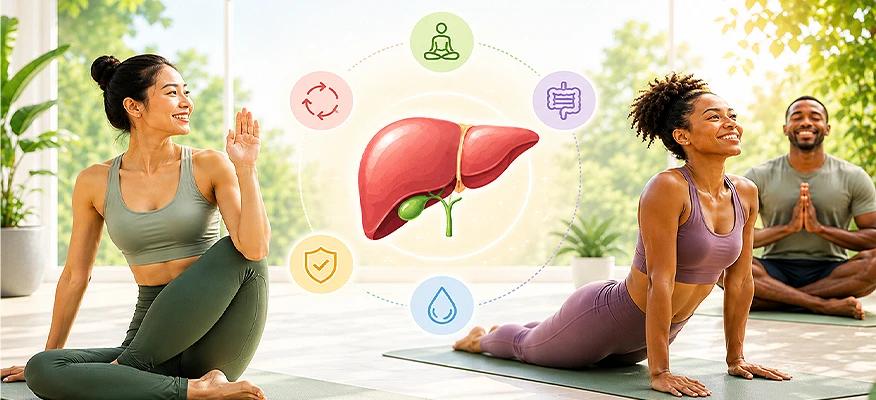
Can yoga actually help reduce fatty liver?
Yes. Yoga can genuinely support liver health, and the science behind it is more compelling than most people expect.
For millions of people across Southeast Asia and Africa living with fatty liver disease — many without even knowing it — the idea that a movement practice rooted in ancient tradition could help a metabolic condition might seem unlikely. But a growing body of clinical research says otherwise.
Non-alcoholic fatty liver disease (NAFLD) now affects an estimated 30% of adults globally, according to the Journal of Hepatology, making it one of the most common liver conditions in the world. It is rising sharply across Nigeria, Indonesia, Philippines and beyond — driven not just by diet, but by chronic stress, inactivity, insulin resistance, and disrupted sleep. These are precisely the mechanisms that yoga, when practised consistently, is shown to address.
Research published in the European Journal of Integrative Medicine found that a structured yoga program significantly reduced liver fat, body weight, and inflammatory markers in participants with NAFLD. The reasons are interconnected: yoga lowers cortisol, improves insulin sensitivity, stimulates abdominal circulation, and activates the parasympathetic nervous system — the body's rest-and-repair mode that chronic stress relentlessly suppresses.
Remember, yoga is not a cure for fatty liver. But it is increasingly recognised by hepatologists and integrative medicine practitioners as one of the most accessible, low-cost, and evidence-backed lifestyle interventions available; particularly for communities where gym access is limited but open space, a mat, and twenty minutes are not.
In this guide, we walk through the seven most effective yoga poses for liver health, explain exactly how each one supports fat metabolism and liver function, and show you how to build a simple practice — whether you are a complete beginner or returning to movement after years away.
How yoga supports liver health
Yoga may support liver health indirectly by improving circulation, digestion, and stress management.
Regular yoga practice may help:
- Improve blood circulation to abdominal organs
- Reduce stress hormones
- Support digestion and metabolism
- Assist with weight management
Yoga for liver
Yoga therapy is a method, where the treatment is done through Yogic practices. It is considered one of many types of complementary and integrative medicine approaches.
It brings together physical and mental disciplines that may help you achieve peacefulness of body and mind. This can help you relax and manage stress and anxiety.
Yoga has many styles, forms, and intensities. The core components of general yoga are:
- Poses: Also called postures, or asanas, yoga poses are a series of movements designed to increase strength and flexibility. In a simple posture, you might lie on the floor while completely relaxed. A difficult posture may have you stretching your physical limits.
- Breathing: Controlling your breathing is an important part of yoga. Yoga teaches that controlling your breathing can help you control your body and quiet your mind.
- Meditation or relaxation: In yoga, you may incorporate meditation or relaxation. Meditation may help you learn to be more mindful and aware of the present moment without judgment.
Yoga to detox the liver
Yoga may support liver health indirectly by improving circulation, digestion, and stress management.
Specific yoga postures are known to stimulate your liver: these are Locust Pose, Frog Pose, Downward Dog, Garland Pose, etc.
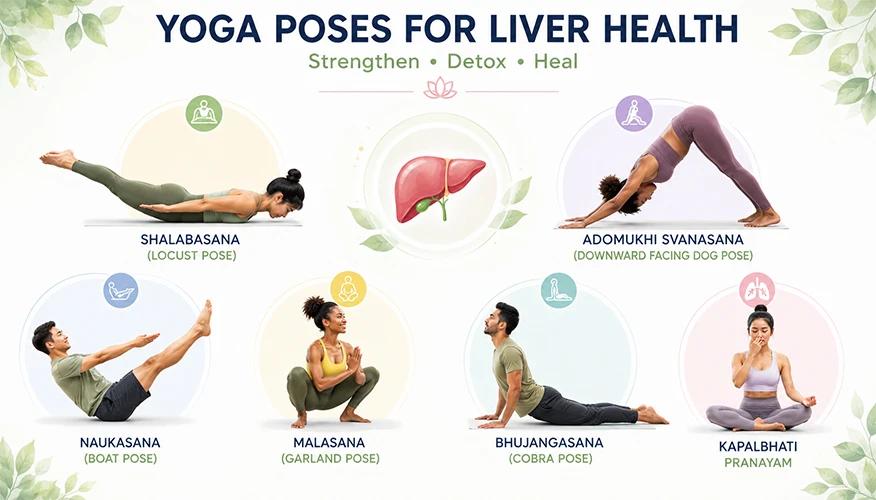
By practicing these postures and combining exercise with a healthy lifestyle, you can bring health and vitality to this vital organ of your system.
Practice these 6 poses regularly to stay healthy and keep your liver functioning smoothly.
1. Shalabasana (Locust Pose)
- Lie down flat on your stomach with your palms placed under your thighs.
- Inhale deeply and lift your legs together.
- Ensure that your knees remain straight and your feet are together.
- Place your chin or forehead on the ground.
- Hold the posture for 10 seconds, slowly bringing your legs down, while breathing normally.
2. Adomukhi Svanasana (Downward Facing Dog Pose)
- Begin on all fours, with your palms beneath your shoulders and your knees below your hips.
- Lift your hips up, straighten your knees and elbows, and form an inverted 'V' shape.
- Now keep the hand's shoulders width apart, with fingers pointed ahead.
- Put pressure on your palms and open your shoulder blades.
- Try to push your heels to the floor.
- Keep your eye focused on your big toes.
- Hold for 8-10 breaths.
3. Naukasana (Boat Pose)
- Lie down on your back
- Lift your upper and lower body to balance your sitting bones.
- Your toes must be aligned with your eyes
- Keep your knees and back straight
- Keep your arms parallel to the ground and pointing forward
- Tighten your abdominal muscles
- Straighten your back
- Inhale and exhale normally
4. Malasana (Garland Pose)
- Begin by standing straight with your arms by the sides of your body.
- Bend your knees, lower your pelvis and place it over your heels.
- Ensure that your feet remain flat on the floor.
- You may either place your palms on the floor beside your feet or join them in front of your chest in a gesture of prayer.
- Spine remains erect.
5. Bhujangasana (Cobra Pose)
- Lie down flat on your stomach with palms placed under your shoulders.
- Keep your feet together, with toes on the ground.
- Inhale and slowly lift your head, shoulders, and torso up at about a 30-degree angle.
- Ensure that your navel remains on the floor, your shoulders are broad, and your head is slightly raised upwards.
- Pressure on your toes– This activates the Sun (Right) and Moon (Left) channels which are connected to your lower back.
- Hold the posture for 10 seconds.
- Slowly bring your torso down while breathing normally.
6. Kapalbhati Pranayam
- Along with these yoga poses for liver detox, you can also add Kapalbhati Pranayama to your daily routine.
- Kapalbhati may improve abdominal circulation and digestion.
- Sit cross-legged, keep your spine erect and inhale deeply, breathing out forcefully through the nostrils. It is recommended to do this breathing technique every day for 15 minutes to fortify liver health. You can start by practicing for 3-5 minutes and gradually increase the duration.
- Many people claim to practice yoga for liver and its health benefits. Yoga focuses on physical exercises consisting of various postures and breathing techniques. A growing body of research evidence supports the belief that certain yoga techniques may improve physical and mental health.
Yoga and gall stones in liver cirrhosis
Do you know what gallstones are? Gallstones are hardened deposits made from digestive fluid called bile that can form in the gallbladder. The gallbladder stores bile produced by the liver, which helps digest fats. According to the Mayo Clinic, gallstones may develop when bile contains too much cholesterol or when the gallbladder does not empty properly.
The function of a gallbladder is to store bile, which is the digestive juice in your body. The liver is responsible for bile secretion and it breaks the soluble and insoluble fats for better absorption.
When bile gets stored in your gallbladder for some time, cholesterol starts producing there. Due to more cholesterol, there is a risk of stone formation in varying sizes.
In some cases, gallstones are not painful. They might stay in the gallbladder for a long time without causing any pain. Pain can trigger if the gallbladder tries to push the stones out of the gallbladder through the bile duct.
Yoga may support digestion and weight management, which can reduce risk factors associated with gallstones.
Some people may also find mild relief from gallstone discomfort through simple home measures such as staying hydrated, eating lighter low-fat meals, applying a warm compress, and avoiding fried or greasy foods that can trigger pain. However, persistent or severe gallstone pain should always be evaluated by a doctor, especially if accompanied by fever, vomiting, or yellowing of the skin.
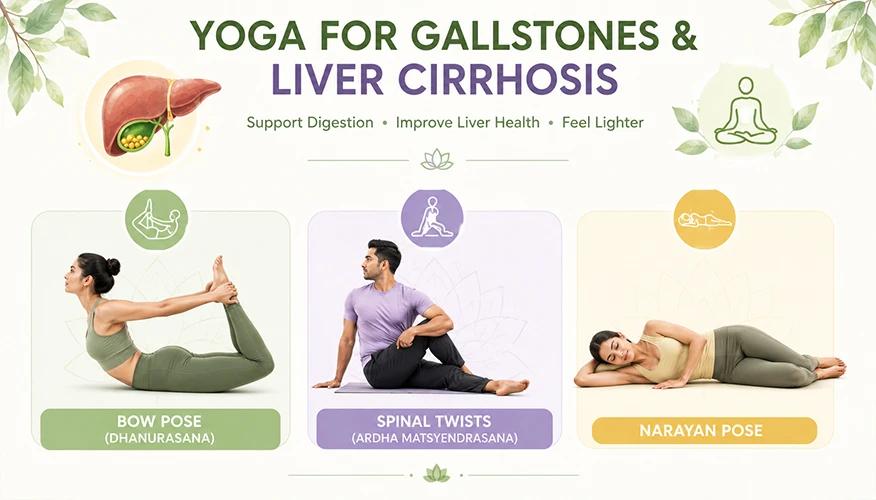
Bow Pose
- Dhanurasana or bow pose can help in improving your gallbladder and many other different organ functions as it gives a therapeutic massage internally.
- This asana helps in strengthening your back and abdominal muscles while providing a good stretch.
- Lie down on your stomach and bend your legs with the support of your knees.
- You have to touch your back and hold the heels using your arms and hands.
- Instead of lifting your body, you can let your ankles go backward like you are stretching your shoulders as much as you can, also allowing your chest to come off the floor.
- You have to hold this asana along with your breath to gently move the body back and forth in a to and fro movement.
Spinal Twists
- Spinal twists help in enhancing your gallbladder function and improving digestion.
- Lie down straight and keep your right foot flat on the floor outside the left knee and then the left leg to the right.
- Then, keep your left ankle on the opposite side of the right buttock.
- Keep your left arm outside the right leg along with the left hand and hold this position.
- Turn your body to the right side with your arm behind the back.
- Turn your back and the neck as much as possible without too much strain. Repeat this with the other leg as well.
Narayan Pose
- Narayan pose is beneficial in improving organ function and alleviating the pain caused by gallstones.
- Lie down on your left side of the body with the arms stretched and behind the end.
- You can even raise your head with your hand's help and support. Till then, your right foot should stay on the left foot.
- You have to hold this pose for at least 10-15 minutes.
- Along with these yoga poses, one should also avoid fried foods, dairy products such as yogurt and cheese, and different fatty foods, especially animal fat and saturated fats.
Precautions
Consult a healthcare professional before practicing yoga if you have liver disease.
Yoga is not a treatment for liver disease. It should be used as a complementary practice alongside medical care.
People who should avoid or modify these poses include:
- Pregnant women
- People with hernia
- Individuals with severe back pain
- People with complications of liver cirrhosis
Conclusion
To conclude, this article postulates that mind-body exercise such as yoga and breathing exercises not only benefits the physical health of an individual but also improves focus and mental strength of the individual.
It also triggers neurohormonal mechanisms that bring about health benefits. Thus, it reduces stress and anxiety and improves brain functioning. It also improves the physical health of cancer patients. Yoga has many health benefits which include the prevention of many liver disorders.
It is therefore highly recommended for individuals to perform yoga from an early age to avoid life-threatening disorders caused due to poor condition of the liver.
Meet our expert

GHBY Team
GHBY TeamMeet our expert
GHBY Team comprises content writers and content editors who specialise in health and lifestyle writing. Always on the lookout for new trends in the health and lifestyle space, Team GHBY follows an audience-first approach. This ensures they bring the latest in the health space to your fingertips, so you can stay ahead in your wellness game.


How was the experience with article?
We'd love to know!