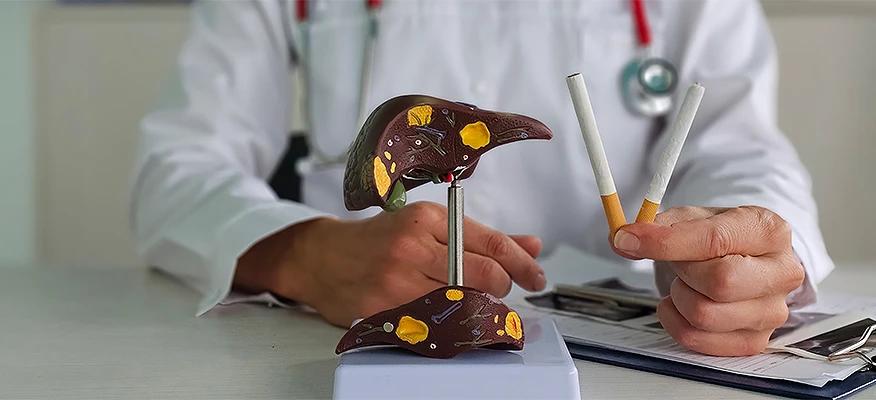
Does smoking affect the liver?
Smoking is harmful and affects all organs, including the liver, which is responsible for detoxification. Smoking causes liver tissue damage, triggers inflammation, and increases the risk of diseases like non-alcoholic fatty liver disease (NAFLD) and liver cancer.
Most people know smoking damages the lungs and heart. But what many don’t realise is that smoking can also place significant stress on the liver—the organ responsible for filtering toxins, processing medications, regulating metabolism, and supporting overall health.
Every cigarette introduces thousands of chemicals into the body. Many of these substances must eventually be broken down by the liver, increasing oxidative stress and inflammation over time. Research suggests that smoking may worsen liver inflammation, accelerate fatty liver disease, increase fibrosis risk, and contribute to liver cancer progression.
This is becoming especially important across Southeast Asia and Africa, where rising rates of fatty liver disease, diabetes, alcohol-related liver disease, and hepatitis are already placing growing pressure on liver health. Smoking may further amplify these risks, especially when combined with poor diet, alcohol use, obesity, or metabolic disorders.
And here’s the encouraging part: the liver has a remarkable ability to recover when harmful exposures are reduced. Studies show that quitting smoking may help lower inflammation and reduce the long-term risk of liver complications over time.
Leading public health experts, including the World Health Organization, continue to warn that tobacco affects far more than the lungs alone—with toxic effects impacting multiple organs throughout the body, including the liver.
In this guide, we explore how smoking affects the liver, the risks linked to long-term tobacco exposure, early warning signs of liver damage, and practical steps that may support liver recovery after quitting smoking.
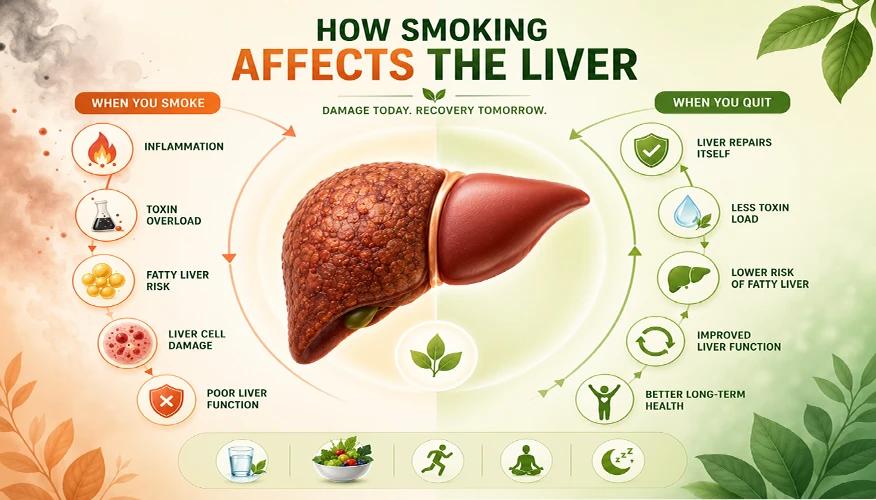
How smoking damages the liver
Smoking does more than damage the lungs—it can also place serious stress on the liver.
Every cigarette contains thousands of chemicals that the liver must break down and remove from the body. Over time, this increases the liver’s workload and may trigger inflammation, oxidative stress, and damage to liver cells.
1. Increased liver inflammation
Smoking can increase inflammation throughout the body, including in the liver. When inflammation becomes chronic, it may interfere with how the liver processes toxins, fats, and nutrients. Long-term inflammation is also linked to liver scarring and a higher risk of liver disease.
2. Oxidative stress & cell damage
Cigarette smoke exposes the body to harmful compounds called free radicals. These unstable molecules can damage liver cells and reduce the liver’s ability to repair itself properly. Research suggests that oxidative stress caused by smoking may worsen existing liver conditions over time.
3. Higher risk of fatty liver disease
Studies show that smoking may increase the risk of non-alcoholic fatty liver disease (NAFLD), a condition where excess fat builds up in the liver. Smoking may worsen insulin resistance and inflammation, both of which are closely linked to fatty liver disease.
4. Changes in liver enzymes
Smoking has also been associated with higher liver enzyme levels in some people. Elevated liver enzymes can be an early warning sign that the liver is under stress or becoming damaged.
5. Reduced ability to remove toxins
The liver plays a major role in filtering toxins from the bloodstream. When smoking repeatedly exposes the liver to harmful chemicals, its ability to process and remove toxins efficiently may gradually become impaired.
Research published in the World Journal of Hepatology notes that smoking may contribute to liver injury, fibrosis, and disease progression through inflammation and oxidative stress.
Smoking and liver cancer risk
Smoking is a significant risk factor for liver cancer, even among people who have quit the habit. Smoke constituents like vinyl chloride, tar, nitrosamines and 4-aminobiphenyl have been associated with hepatocellular carcinoma, the most common type of liver cancer.
Studies have shown that smokers are at an increased risk of developing liver cancer compared to non-smokers. This risk is even higher for heavy smokers or those who have smoked for many years.
Smoking shows a strong association with liver tumours, which can be cancerous or non-cancerous. One study found that smokers had a higher incidence of liver tumours than non-smokers and that the risk increased with the number of daily cigarettes.
In people with other risk factors like hepatitis B or C, heavy alcohol consumption and obesity, smoking can increase the risk of developing liver cancer.
It can damage liver function, leading to inflammation and scarring of the liver, which can increase the risk of developing liver cancer. Smoking is also known to weaken the immune response, making it challenging for the body to fight off cancer cells.
Can quitting smoking improve liver health?
Quitting smoking can help improve liver function and reverse some of the damage caused by smoking. However, this depends upon the amount of liver damage that has already occurred.
If you are a smoker and decide to quit for your health, here are some of the ways in which quitting smoking can benefit liver health:
1. Reduced liver enzymes
Quitting smoking has been shown to reduce levels of liver enzymes in the bloodstream, which is a sign of improved liver function.
2. Reduced inflammation
Quitting smoking can also reduce inflammation in the liver, which can help to prevent further damage and promote the healing of existing liver damage.

3. Improves blood flow
Smoking can reduce blood flow to the liver, which can have direct effects on liver function. By quitting smoking, you can help restore the blood flow to the liver enabling the organ to function better.
4. Lowers your risk for liver cancer
By quitting smoking, you are automatically lowering your risk for liver cancer. Your risk remains even after you quit smoking, but it is significantly lower than in smokers. A study found that the risk of liver cancer among people who quit smoking was similar to that of non-smokers, while current smokers had a significantly higher risk.
5. Lowers your risk for NAFLD
Giving up smoking entirely can help reduce the risk of non-alcoholic fatty liver disease, a condition in which fat builds up in the liver.
Smoking vs alcohol: Which is worse for liver health?
Both alcohol and smoking significantly damage the liver, and their combination sharply increases the risk of permanent damage. Alcohol-related liver damage is a leading cause of chronic liver disease worldwide, causing inflammation and scarring (cirrhosis) over time.
While smoking damage is often less discussed, harmful chemicals from smoke increase oxidative stress and inflammation, worsening existing liver conditions and slowing natural healing. Ultimately, the risk is highest when the habits are combined.
How long does the liver take to recover after quitting smoking?
The liver has a strong ability to repair itself, especially in the early stages of damage. Quitting smoking can start improving liver function quickly, showing reduced liver enzyme levels and decreased inflammation within weeks. However, the extent of damage determines full recovery. Mild damage may improve within weeks to months, but severe scarring (cirrhosis) may not fully reverse. Consistent abstinence and healthy lifestyle changes are crucial for long-term recovery.
Tips to protect your liver
- Maintain a healthy diet, focusing on whole foods, fruits, vegetables, and lean proteins.
- Exercise regularly, aiming for at least 30 minutes of moderate activity most days of the week.
- Limit or avoid alcohol consumption.
- Maintain a healthy weight.
- Get vaccinated against hepatitis B and C.
- Be cautious with medications and use them only as advised.
- Quit smoking.
Conclusion
By now, you would have understood that smoking and liver damage are inherently linked. Smoking can significantly impact liver function, causing damage to liver cells, elevating liver enzymes, promoting inflammation, and increasing the risk of liver cancer. Smokers are also at a higher risk of developing non-alcoholic fatty liver disease.
To protect liver function, individuals should take steps to quit smoking and adopt a healthy lifestyle, including eating a balanced diet, maintaining a healthy weight, and limiting alcohol consumption.
Regular exercise and getting vaccinated against hepatitis B and C can also help to protect liver health. Overall, it is essential to prioritise liver health and take proactive steps to protect this vital organ. By quitting smoking and adopting healthy habits, individuals can reduce their risk of liver damage, inflammation, and cancer and promote optimal liver function for a lifetime of good health.
Meet our expert

Meet our expert
Dr. Irina Borisovna Stefanenko, a medical doctor based in Ukraine, graduated from Vinnitsa State Medical University in 1995. Between 1995 and 2000, Dr. Stefanenko pursued postgraduate studies and engaged in scientific activities at Vinnytsa Medical University in Ukraine.
How was the experience with article?
We'd love to know!