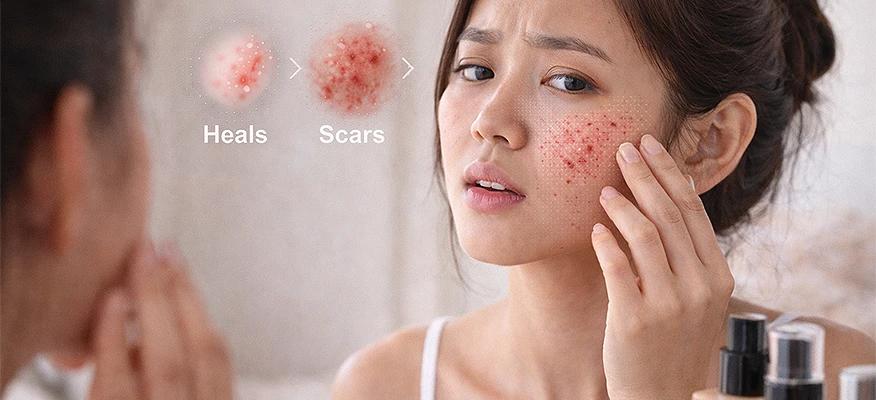
You’ve probably noticed it before—two similar breakouts, yet only one leaves a mark behind. While one pimple fades quietly within days, another lingers, turning into a dark spot or even a lasting scar. It can feel unpredictable, and often frustrating.
For many people, it’s not just one breakout—it’s the same spot that flares up again and again, making the skin more likely to mark over time.
The difference lies in how your skin responds to inflammation and heals itself.
When a pimple becomes more inflamed—whether due to its depth, bacteria, or even picking and squeezing—it can damage the surrounding skin tissue. In response, your body tries to repair this damage by producing collagen. But if this process is disrupted, it can lead to either too little collagen (causing indented scars) or too much (leading to raised scars).
Clinical insights from the American Academy of Dermatology highlight that the severity of inflammation is one of the biggest factors determining whether acne will scar. Dermatology research consistently shows that delayed treatment, repeated breakouts in the same area, and skin type can all influence how well your skin heals.
And context matters too. In regions like Southeast Asia and East Africa, heat, humidity, and higher melanin levels in the skin can make post-acne marks—especially dark spots—more noticeable and longer-lasting, even when the original pimple has healed.
The reassuring part is that not all acne leads to scarring—and much of it is preventable with the right approach.
In this article, we break down why some pimples scar, what increases your risk, and what you can do to help your skin heal better, so you can reduce long-term marks and support clearer, healthier skin.
What happens when a pimple forms?

Every pimple begins in the pilosebaceous unit, a structural unit comprising the hair follicle and its oil-producing gland. This is why acne typically shows up on your face, chest, back, and shoulders, where these units are most active.
The trouble begins when several things happen at once:
- Dead skin cells stick together instead of shedding normally, creating a plug that blocks your pore
- Oil production increases, often triggered by hormones like androgens or factors like IGF-1
- Bacteria called Cutibacterium acnes multiply in this blocked, oil-rich environment
- Your immune system responds by sending inflammatory cells to fight the bacteria
As pressure builds inside the blocked follicle, it can rupture like a tiny balloon, spilling its contents—bacteria, oil, and dead cells—into the surrounding skin tissue. This spillage triggers your body's alarm system, leading to pimples.
For women living in hot, humid climates, this process can be accelerated by sweat, pollution, and heavy cosmetic products that further clog pores. The key is to understand that this inflammatory cascade sets the stage for either healing or scarring, depending on how deep and intense it gets.
Why do some pimples heal without scarring
Most mild pimples are actually designed to heal cleanly. When inflammation is short-lived and stays mainly in the upper layers of your skin, your body can repair the damage without leaving permanent marks.
Here's what happens during successful healing:
- The follicle wall stays mostly intact, preventing major spillage into surrounding tissue
- Specialized enzymes clear away damaged tissue in a balanced way
- New collagen forms in just the right amounts to fill any tiny gaps
- Blood flow remains good, delivering nutrients needed for repair
You might notice some temporary redness or dark marks after these pimples heal. However, they're not true scars and usually fade over time without any permanent textural changes to your skin.
Why do some pimples turn into acne scars
Acne scars form when inflammation goes deeper and lasts longer, extending into the middle or deep layers of your skin. The deeper the damage, the harder it is for your skin to return to its original smooth state.
Several factors push a pimple toward scarring:
- Deep tissue damage: When the follicle wall ruptures completely, it creates extensive destruction in the surrounding skin tissue. This is especially common with severe inflammatory lesions like nodules and cysts.
- Secondary trauma: This is where many of us accidentally make things worse. Squeezing, picking, or using harsh scrubs on inflamed pimples increases injury and infection risk, pushing mild inflammation into scar territory.
- Abnormal healing response: Sometimes your body's repair system goes haywire. It might produce too much collagen, creating raised scars, or break down too much collagen, leaving depressed areas.
At the cellular level, persistent inflammation activates powerful pathways that drive abnormal tissue formation. For women with darker skin tones, inflammation is also more likely to cause post-acne hyperpigmentation, which can be just as distressing as textural scars.
Types of acne scars
Understanding the different types of acne scars helps you recognize what you're dealing with and choose appropriate treatments. Most acne scars fall into a few distinct categories:
- Atrophic (depressed) scars make up ~80–90% of acne scars and occur due to collagen loss during healing. Common types include:
- Ice-pick: narrow, deep pits
- Boxcar: wider, sharp-edged depressions
- Rolling: broad, wavy indentations
- Raised scars form because of excess collagen:
- Hypertrophic scars: Raised but stay within the pimple area
- Keloid scars: Grow beyond the original spot; sometimes itchy or painful
- Post-inflammatory marks (not true scars):
- Post-inflammatory hyperpigmentation (PIH): Flat brown/black spots (more common in darker skin)
- Post-inflammatory erythema (PIE): Red/pink marks (more visible in lighter skin)
Why do some people scar more easily than others
If you've ever wondered why your friend's skin bounces back from breakouts while yours seems to hold onto every blemish, genetics plays a huge role. Your DNA influences how your immune system responds to inflammation, how your body makes and breaks down collagen, and how efficiently your skin repairs itself.
Skin type and color also matter significantly. People with darker skin tones have a higher risk of developing both post-acne marks and keloid or hypertrophic scars, especially on the chest, shoulders, and jawline.
Hormonal factors can also tip the scales. Elevated androgens and IGF-1, influenced by high glycemic diets, dairy intake, or metabolic issues, tend to worsen inflammatory acne and indirectly increase your scarring risk.
The severity and duration of your acne also play a crucial role. Untreated, persistent inflammatory lesions have more time to damage the deeper structures of your skin. This is why early, consistent treatment is important.
How long do acne marks take to fade?
The timeline for acne mark fading depends largely on what type of marks you're dealing with. It's important to distinguish between temporary discoloration and permanent structural changes.
- Red acne marks from PIE typically fade over several months, though this process can be slower with ongoing sun exposure or irritation. These marks represent dilated blood vessels and inflammation that gradually return to normal as healing progresses.
- PIH can persist for months to years, especially in people with darker skin tones.
Sun exposure is the biggest factor that determines how long pimple marks last. UV rays stimulate melanin production, which can darken existing marks and significantly prolong their healing time. This is particularly relevant if you live in a sunny climate. The good news is that proper sun protection, along with gentle anti-inflammatory skincare and pigment-reducing ingredients, can speed up the fading process considerably.
How to prevent acne scars
Prevention is always easier than treatment when it comes to acne scars. The most effective strategies focus on controlling inflammation early and protecting your skin during the healing process.
- Treat acne early and consistently: The sooner you address inflammatory lesions, the less likely they are to cause lasting damage. This might mean using over-the-counter treatments with benzoyl peroxide or salicylic acid, or seeing a dermatologist for prescription options.
- Keep your hands off: This cannot be emphasized enough. Picking, squeezing, or using sharp tools on pimples dramatically increases your risk of scarring by introducing bacteria and causing additional trauma to already inflamed tissue.
- Use gentle, appropriate skincare: Choose mild, fragrance-free cleansers and avoid harsh scrubs or alcohol-based products that can disrupt your skin barrier and prolong inflammation. In hot, humid climates, look for oil-free, non-comedogenic moisturizers and sunscreens.
- Protect from sun damage: Daily broad-spectrum SPF (at least 30) is crucial for preventing post-acne marks and supporting proper healing. Wide-brimmed hats and seeking shade can provide additional protection.
- Support healthy healing: Your skin needs adequate protein, vitamin C, zinc, and iron to build collagen and fight infection effectively. Managing stress and getting enough sleep also support hormonal balance and tissue repair.
Can acne scars be treated?

Yes, many treatments can significantly improve the appearance of acne scars, though complete elimination isn't always possible. The key is choosing the right approach for your specific scar type and skin tone.
For depressed acne scars, several options have good evidence backing them:
- Topical retinoids stimulate collagen production and can help with both shallow scars and dark marks
- Chemical peels using glycolic, salicylic, or trichloroacetic acid promote skin renewal and collagen remodeling, though they require caution in darker skin
- Microneedling creates controlled micro-injuries that stimulate new collagen formation and is considered relatively safe for all skin tones when performed correctly
- Professional procedures like subcision, dermal fillers, and laser treatments can address deeper scars but require experienced providers
For raised scars (hypertrophic and keloid):
- Steroid injections are often the first-line treatment to flatten and soften raised tissue
- Silicone sheets or gels used consistently for months can reduce thickness and symptoms
- Combination treatments may include cryotherapy or laser therapy, along with steroids for resistant cases
For post-acne marks, topical treatments with ingredients like azelaic acid, niacinamide, or hydroquinone (where appropriate) can help fade discoloration over time.
When to see a dermatologist
Seeing a dermatologist can save time, money, and help prevent scarring. Consider professional help if:
- Your acne is moderate to severe, especially with painful cysts or nodules
- You’re developing new scars, or marks aren’t fading after months
- Over-the-counter products don’t work after 6–8 weeks, or worsen your skin
- Acne affects your confidence, work, or relationships
- You’re prone to keloids/severe scarring and are considering procedures
- You’re pregnant, breastfeeding, or have medical conditions needing safe treatment options
Conclusion
The journey from pimple to scar is largely determined by the depth and duration of inflammation, how your individual skin heals, and the care you provide during the crucial healing period. While genetics, skin color, and hormones all influence your risk, many factors remain within your control.
By understanding how acne scars form, you can make informed decisions about prevention and treatment. Focus on early, gentle acne care, protect your skin from sun damage, and resist the urge to pick or squeeze. The key is working with a knowledgeable professional who understands your skin type and can recommend appropriate options for your specific situation and budget.
Meet our expert

Meet our expert
Dr Sylvia Kama-Kieghe is a UK-based General Practitioner with a special interest in Women's Health and founder of Askawayhealth. She's also a tutor and medical student examiner. She is a Fellow of the Royal College of General Practitioners (FRCGP), Fellow of the Royal Society of Public Health (FRSPH), Fellow of the Royal Society of Medicine (FRSM), and holds a Diploma of the Faculty of Sexual and Reproductive Healthcare (DFSRH).
How was the experience with article?
We'd love to know!